LCD vs. DLP in the Boardroom: An Honest Performance Comparison for US Business Buyers
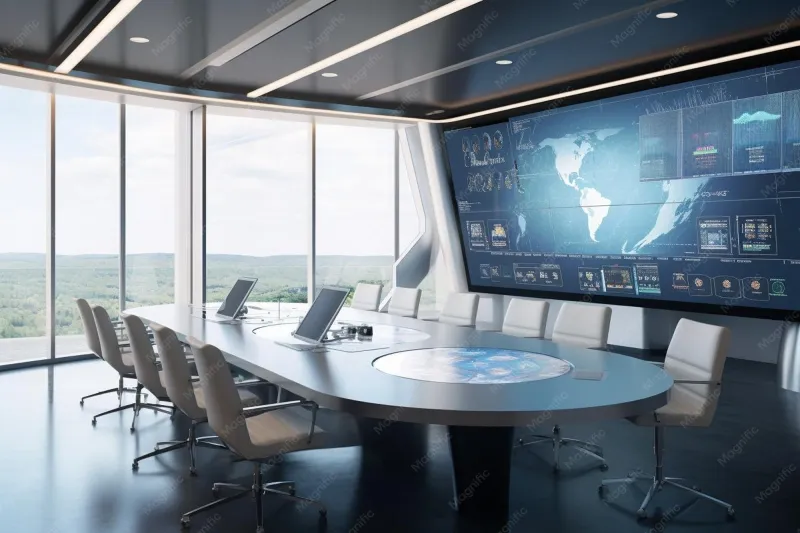
Photo: business boardroom projector presentation corporate conference room professional, via img.freepik.com
When a company equips a boardroom, a training facility, or a multi-purpose conference center, the projector selection carries consequences that extend well beyond the initial purchase order. The wrong technology choice can mean squinting at washed-out slides during a client pitch, fielding complaints about eye fatigue after a two-hour all-hands meeting, or absorbing unexpected lamp and maintenance costs that quietly erode the IT budget over a three-year horizon.
Two technologies dominate the business projector market in the United States: LCD (Liquid Crystal Display) and DLP (Digital Light Processing). Both are mature, commercially proven platforms — but they are not interchangeable, and the differences between them are particularly consequential in demanding professional environments. This guide examines those differences with specificity, drawing on the performance characteristics of Sanyo's LCD projector lineup to illustrate where LCD technology holds a genuine advantage for boardroom and enterprise applications.
How the Two Technologies Actually Work
Understanding the fundamental architecture of each platform clarifies why they behave differently in practice.
LCD projectors pass light from a high-pressure lamp through three separate LCD panels — one each for red, green, and blue — and then recombine those channels through a prism before projecting the unified image through the lens. Because all three color channels are rendered simultaneously and continuously, LCD projectors produce a naturally rich, saturated image with no sequential color processing.
DLP projectors use a chip covered with microscopic mirrors (a Digital Micromirror Device, or DMD) that tilt rapidly to modulate light. In single-chip DLP designs — which account for the majority of business-category units — color is produced by spinning a color wheel in front of a white light source, cycling through red, green, and blue segments at high speed. The human eye integrates these rapidly alternating pulses into a perceived full-color image.
This architectural difference has direct, measurable consequences for the four criteria that matter most to business buyers.
Color Fidelity: Where LCD Has a Structural Advantage
For business presentations, color accuracy is not merely an aesthetic preference — it is a functional requirement. Corporate brand guidelines specify precise colors for logos, slide templates, and marketing materials. A projector that shifts a brand's signature blue toward purple, or renders a financial chart's red-green contrast as ambiguous, creates real communication problems in client-facing settings.
Because LCD projectors render all three color channels simultaneously, they maintain consistent color saturation across a wide range of content types. Sanyo's LCD business projectors are calibrated to cover a broad percentage of the sRGB color space — the standard gamut for Windows and macOS operating systems — which means that colors displayed on a laptop screen translate to the projected image with high fidelity.
Single-chip DLP projectors can struggle in this area. The color wheel approach introduces a phenomenon known as color breakup or the "rainbow effect" — brief flashes of red, green, or blue that some viewers perceive when their eyes move across the screen. While manufacturers have mitigated this through faster wheel rotation and six-segment wheel designs, the issue remains a documented concern, particularly for viewers who are sensitive to it. In a boardroom where client comfort and sustained attention are priorities, this is a non-trivial consideration.
Three-chip DLP projectors eliminate the rainbow effect but are substantially more expensive — typically priced for large-venue or cinema applications rather than standard conference room deployment.
Brightness and Uniformity Across the Screen
Both LCD and DLP projectors are available across a wide lumen range, from compact 3,000-lumen units suited to small conference rooms to high-output models exceeding 6,000 lumens for large boardrooms and training centers.
However, raw lumen output tells only part of the story. Brightness uniformity — how evenly light is distributed across the projected image — is equally important for professional applications. A projector with strong center brightness but significantly dimmer corners will make slide content appear inconsistent, particularly on large screens.
Sanyo LCD projectors are engineered with optical systems that prioritize uniformity, making them well-suited to the wide screens common in US corporate conference rooms. The three-panel architecture also means that brightness is delivered across all colors simultaneously, rather than cycling through them — which contributes to the perception of a brighter, more stable image under mixed ambient lighting conditions.
Lamp Lifespan, Maintenance, and Total Cost of Ownership
For IT managers and facilities directors responsible for multi-room deployments, total cost of ownership (TCO) over a three-to-five-year period often outweighs the sticker price of the unit itself. Two cost centers dominate the TCO calculation: lamp replacement and maintenance labor.
Sanyo LCD projectors in the business category are designed with accessible lamp modules and clearly documented replacement intervals, typically rated at 3,000 to 5,000 hours in standard mode and up to 6,000 or more hours in eco-lamp mode. For an organization running presentations eight hours per day, five days per week, eco-mode lamp life can translate to more than two years of operation before a replacement is needed.
DLP projectors share similar lamp replacement economics at the component level, but their color wheels introduce an additional mechanical wear point that LCD projectors do not have. Color wheel bearings can degrade over time, and replacement — where available — adds a service cost that does not appear in the initial TCO estimate.
For organizations managing a fleet of projectors across multiple rooms or facilities, Sanyo's consistent filter and lamp maintenance schedules simplify inventory management and reduce the administrative burden on IT staff.
Real-World Performance in High-Stakes Presentations
Spec sheet comparisons have limits. The most instructive evaluation of any projector technology happens under conditions that mirror actual use: a 90-minute executive presentation with mixed content — branded slides, embedded video, live screen sharing from a laptop, and a Q&A segment under partially dimmed overhead lights.
In this scenario, the attributes of LCD technology aggregate into a meaningful performance advantage. The color consistency ensures that the company's brand palette reads correctly whether the content is a static title slide or a motion graphic. The absence of the rainbow effect keeps the audience focused on the content rather than the display medium. The brightness uniformity ensures that data in the corners of a wide slide is as legible as content in the center.
DLP projectors perform admirably in many of these same conditions, and for organizations with specific requirements — such as extremely compact form factors or the sharpest possible edge definition for technical diagrams — a DLP unit may be the appropriate choice. But for the broad profile of US business users who prioritize color accuracy, viewer comfort, and reliable long-term performance, Sanyo's LCD platform represents a technology alignment that is difficult to argue against.
Making the Right Choice for Your Organization
The decision between LCD and DLP is not a question of which technology is objectively superior — it is a question of which technology is better matched to your specific environment, content type, and operational requirements.
For organizations that present branded content to clients, conduct extended training sessions, or operate in partially lit rooms where color accuracy and viewer comfort are paramount, the structural characteristics of LCD projection — simultaneous color rendering, uniform brightness, and predictable maintenance costs — align directly with those priorities.
Sanyo's LCD projector lineup has been developed with precisely these professional demands in mind. Evaluating a unit in your actual boardroom, with your actual content, remains the most reliable path to a confident purchasing decision. The investment in that evaluation is modest; the cost of the wrong choice, measured over years of daily use, is considerably higher.